Project Notes
Services
Web App Development
UI/UX Design
SaaS Development
User Accounts
Dashboard Development
Responsive Design
Stack
Overview
Overview
Starry Chart is a custom web application designed to make everyday routines a little easier — and a lot more rewarding — for families.
The idea is simple: parents create tasks and routines for their children, children earn stars for completing them, and those stars build towards rewards.
Behind that simple experience is a much more complete product.
The app needed to handle multiple children, recurring routines, different task categories, reward goals, progress tracking, streaks and reporting while still feeling friendly enough for families to actually enjoy using it.
I designed and developed the experience around that balance: enough functionality to be genuinely useful to parents, without turning a children's routine chart into complicated productivity software.
The Challenge
The Challenge
Reward charts work because they make progress visible.
The challenge with turning that idea into a web application is keeping the immediacy of a physical star chart while adding everything a digital product can do better.
Parents need to be able to create and manage routines quickly. Tasks may happen every day or belong to particular parts of the day. Different children need their own progress, rewards and histories, while the parent still needs one clear place to manage the family.
At the same time, the product is partly for children.
That means an interface designed purely like an admin dashboard would miss the point.
Starry Chart needed to feel colourful, encouraging and playful without becoming difficult for an adult to navigate.
The Solution
The Solution
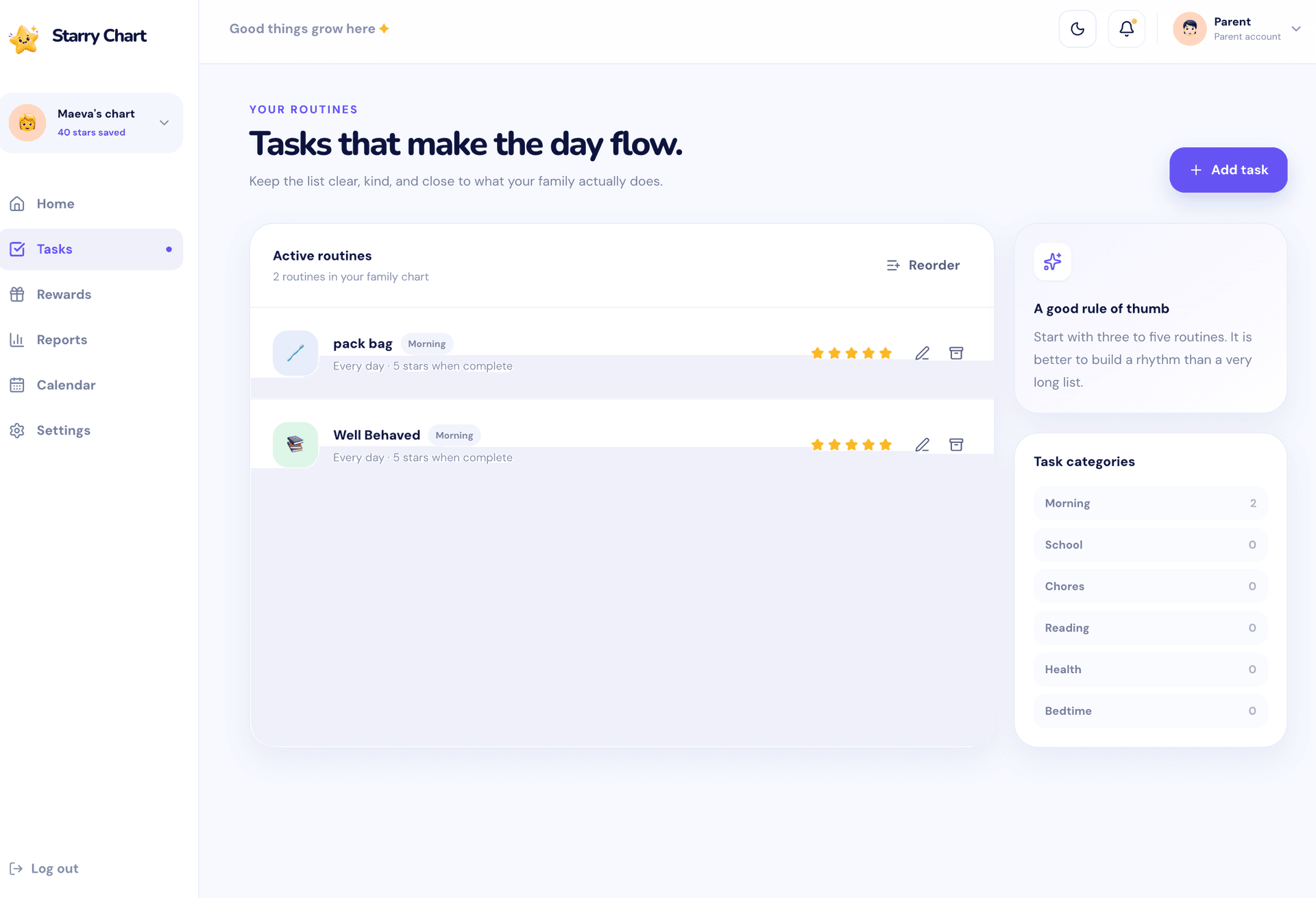
I built the application around a straightforward parent dashboard where the family's routines can be managed in one place.
Parents can create tasks, organise them into categories such as morning, school, chores, reading, health or bedtime, and decide how many stars completing each task should earn.
The child's progress then becomes visible rather than abstract.
Stars accumulate, streaks can be celebrated and rewards give children something tangible to work towards. The interface reinforces that progress throughout the experience rather than limiting it to a single statistics screen.
Multiple children can also exist within the same family account, allowing each child to maintain their own star total, routine and progress while remaining manageable from the parent's account.Designing for parents and children at the same time
The visual direction was an important part of the project.
Starry Chart needed to feel like something children would actually want to interact with, but I did not want it to become visually chaotic.
The result uses a soft, playful visual system built around stars, character illustrations, rounded interfaces and bright reward colours, while the underlying dashboards remain structured and predictable.
The public-facing website carries that identity further with a more imaginative space-inspired direction, while the application itself becomes slightly calmer and more functional.
That distinction lets the marketing site feel memorable without making everyday tasks harder to manage.
Routines, rewards and progress
The core application revolves around three connected ideas.
Parents create routines.
Children complete those routines and earn stars.
Those stars move them towards rewards.
Because those pieces share the same system, the application can provide a much clearer picture of progress than a standalone checklist.
Parents can see how consistently routines are being completed, children can see what they are working towards, and achievements become something visible that can be celebrated.
The application also includes reporting and calendar views so progress can be understood over time rather than only as a current star balance.
Built as a product, not just a website
Starry Chart is another example of the kind of project where the distinction between a website and a web application becomes important.
The public website introduces the idea and explains the benefits.
Once logged in, the product itself takes over.
There are accounts, family data, children, task management, recurring routines, rewards, progress calculations and application state that all need to work together consistently.
That means the development process is less about creating individual pages and more about designing a system.
The question becomes not just what should this screen look like?, but what happens when a parent adds another child, changes a task, completes a routine or reaches a reward?
Those interconnected flows are what turn the idea into an actual product.
The Result
The Result
Starry Chart turns a familiar parenting idea into a complete digital experience.
Parents get a central place to create routines, manage children, define rewards and understand progress.
Children get something much more visual and motivating than another checklist.
And the platform has room to grow beyond the initial star-chart concept as additional family, reporting and reward features are developed.
For me, it is also a good example of the kind of web-development project I particularly enjoy: starting with a relatively simple real-world idea and designing the system needed to make it work properly online.
The end result isn't just a website explaining the product.
The website is the product.