Project Notes
Year
2026
Services
Web App Development
SaaS Development
UI/UX Design
API Integration
PWA Development
Responsive Design
Stack
Overview
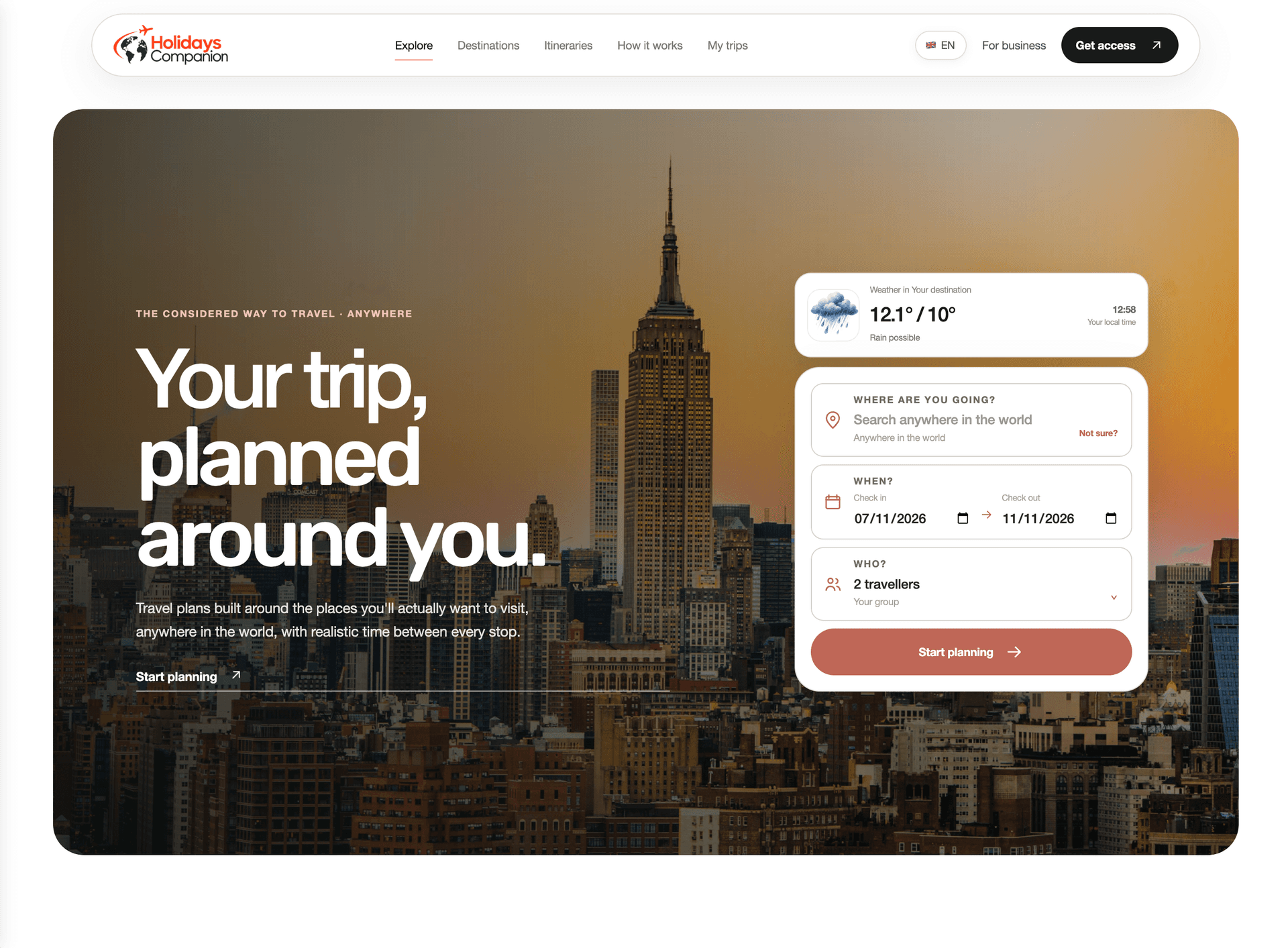
Holidays Companion is a custom travel web application built around a simple idea: the useful information for a holiday should not be scattered across emails, PDFs, booking confirmations, map links and screenshots.
Instead, travel agencies can create a structured itinerary and give their customer one branded digital companion to use before and during the trip.
I developed Holidays Companion as a multi-agency platform rather than a conventional travel website. Agencies can manage their own travellers, itineraries and branding, while each traveller receives a mobile-friendly version of their trip with the information that matters to them.
The result sits somewhere between a SaaS platform, itinerary builder and travel companion
The Challenge
Travel itineraries contain a surprising amount of moving information.
There are destinations, dates, accommodation, transport, activities, restaurants, places, timings and recommendations. Once the traveller actually arrives, other information becomes important too: what is happening today, what is coming next, what the weather looks like and what is nearby.
The platform therefore had two very different audiences.
Travel agencies needed an efficient way to create and manage trips without exposing information belonging to another agency.
Travellers needed something much simpler.
They should be able to open their itinerary on a phone and immediately understand where they are, what they are doing and what comes next without feeling as though they are using an administration system.
The challenge was building those two experiences on top of the same underlying trip data.
The Solution
I built Holidays Companion around a multi-tenant agency system.
Each agency has its own workspace, travellers, itineraries and brand settings, allowing the platform to support multiple travel businesses while keeping their data separated.
Agencies can build itineraries around destinations and individual stops, with real place information incorporated through Google Places rather than requiring every location to be entered manually.
Once a trip is ready, the traveller receives a secure link to their own companion.
The traveller-facing experience was designed primarily for mobile use. Instead of presenting the entire itinerary as one long document, the app understands the current destination and day of the trip so it can surface the information that is most useful at that moment.
This includes upcoming itinerary stops, completed and skipped activities, local weather and nearby recommendations.
The Result
A companion that changes with the trip
One of the more interesting parts of the project was making the itinerary feel alive rather than simply reproducing a PDF online.
Holidays Companion can detect the traveller's current day within the itinerary and highlight what is coming next.
Stops can be marked as planned, completed or skipped, and those changes persist for the traveller rather than resetting every time the app is opened.
Weather data is also incorporated into the experience. This means the companion can identify potential conflicts between planned activities and local conditions rather than showing weather as an unrelated widget.
Nearby recommendations can then use the traveller's destination to surface useful places such as restaurants and other points of interest.
The idea is that the application becomes progressively more useful once the holiday has actually started.
Designed for travel agencies as well as travellers
Holidays Companion was also built as a product that agencies can make their own.
Each agency can use its own branding and imagery so the traveller experience feels like an extension of the business they booked through rather than a completely separate third-party service.
Agencies can have their own public profile, featured destinations and promotional content, while itinerary cover imagery can also be managed through the platform.
QR codes and embeddable website functionality give agencies additional ways to connect their existing marketing with their Holidays Companion presence.
This was important to the wider product idea.
The goal was not just to build an itinerary tool for one travel company. It was to create an application that could support multiple agencies while allowing each of them to maintain their own identity.
Built for the traveller's phone
A travel application has to remain useful in circumstances where a normal website may struggle.
Travellers may be walking through an unfamiliar city, switching between mobile networks or dealing with unreliable hotel Wi-Fi.
For that reason, the traveller experience was developed as a progressive web application with offline fallback behaviour rather than assuming a perfect connection at all times.
Maps, itinerary information and the wider interface are designed around smaller screens because that is where the companion is most likely to be used.
The interface also avoids exposing the complexity of the agency dashboard.
The traveller does not need to understand how the itinerary was created. They just need to know what happens next.
The Result
Holidays Companion has become a complete travel web application rather than simply an itinerary website.
Travel agencies can create and manage travellers and trips, customise the experience around their brand and share secure itineraries without manually assembling a new collection of documents for every customer.
Travellers receive a much more useful interface for the trip itself, bringing together their itinerary, destinations, maps, weather and recommendations in one place.
For me, the project is also a good example of the kind of custom web development I increasingly work on.
There was no existing website template to customise because the product itself had to be designed.
That meant thinking about tenant security, user journeys, data persistence, third-party APIs, mobile behaviour and the relationship between an administration platform and the much simpler experience eventually seen by the customer.
It is the difference between building a website that describes a service and building the software that helps deliver it.