Project Notes
Services
Web App Development
Website Design
User Accounts
Leaderboard Development
Custom Forms
Admin Dashboard
Stack
Overview
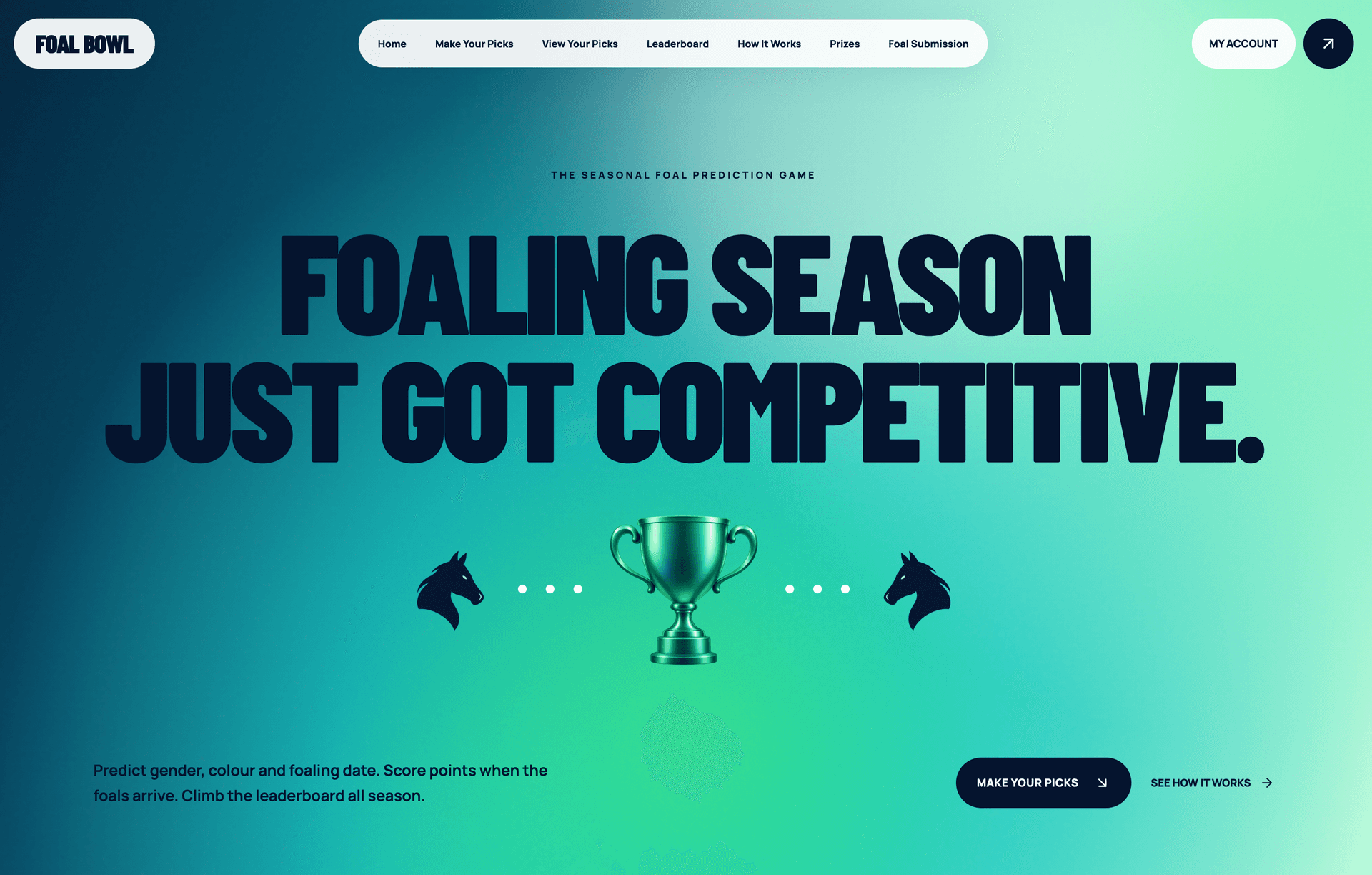
Foal Bowl is a seasonal prediction platform built around an unusual idea: turning foal predictions into a proper online competition rather than managing entries, results and prizes manually.
The project needed considerably more than a conventional website.
Visitors needed to understand how the competition worked, create an account, make and review their picks, follow the leaderboard and see prizes. Breeders also needed their own submission process, while the administration side had to support approvals, results and future seasons.
I developed Foal Bowl as a custom web application so those different parts could work together as one system.
The result is a platform that can run the competition itself rather than simply advertise it.
The Challenge
The biggest challenge was taking a competition with several different participants and making the process feel simple.
A player coming to Foal Bowl primarily wants to know how to enter, make their picks and see how they are doing.
A breeder has a different journey. They need to submit a foal, provide the required information and later submit a result.
Sponsors and prize contributors have another route again.
Behind all of that, the platform needs rules.
Entries need deadlines. Picks need to lock when the competition reaches the appropriate stage. Foal submissions need approval. Results affect the leaderboard. Users need access to their own information without being able to alter parts of the competition that should already be closed.
The website therefore needed to handle both the public-facing experience and the logic underneath it.
The Solution
I built Foal Bowl around a custom account and competition system.
Registered users can make their selections through the platform and return to review their picks rather than relying on external forms or spreadsheets.
Competition deadlines are built into the experience so entries can be locked at the correct point, protecting the integrity of the game once predictions are closed.
A dedicated leaderboard then gives the competition a visible ongoing result rather than leaving scoring behind the scenes.
The breeder side of Foal Bowl was developed as its own workflow.
Breeders can submit foals for inclusion, with submissions going through an approval process before becoming part of the competition. A QR-based Golden Ticket concept also creates a bridge between the physical breeding world and the online platform, giving participants a direct route into the relevant digital experience.
Results can later be submitted through the site, allowing the same system to support the full journey from initial foal entry through to the final competition outcome.
The wider website also includes dedicated areas for rules, prizes, sponsorship, user accounts and previous competition information.
Importantly, the platform was structured with future seasons in mind. Foal Bowl is not intended to be a one-off campaign page that has to be rebuilt from scratch every year. The system can support recurring competitions, new entries and an archive as the project grows.
The Result
Foal Bowl now has a purpose-built platform capable of managing a competition that would otherwise involve a substantial amount of disconnected administration.
Users have one place to create an account, make predictions, follow results and view their standing.
Breeders can participate through their own submission process.
Administrators have a clearer way to review entries, manage results and operate the competition behind the scenes.
For me, this is a good example of where a website becomes a genuine web application.
The value is not just in how the pages look. It is in taking the rules of an idea — who can enter, what they can submit, when things lock, how results are recorded and how a leaderboard changes — and turning those rules into a usable digital product.
Those are often some of my favourite development projects because there is no off-the-shelf template for the idea.
You have to understand how the thing is supposed to work first, and then build the website around it.