Strategy
—18 December 2025
How to Choose the Right Web Developer for Your Business
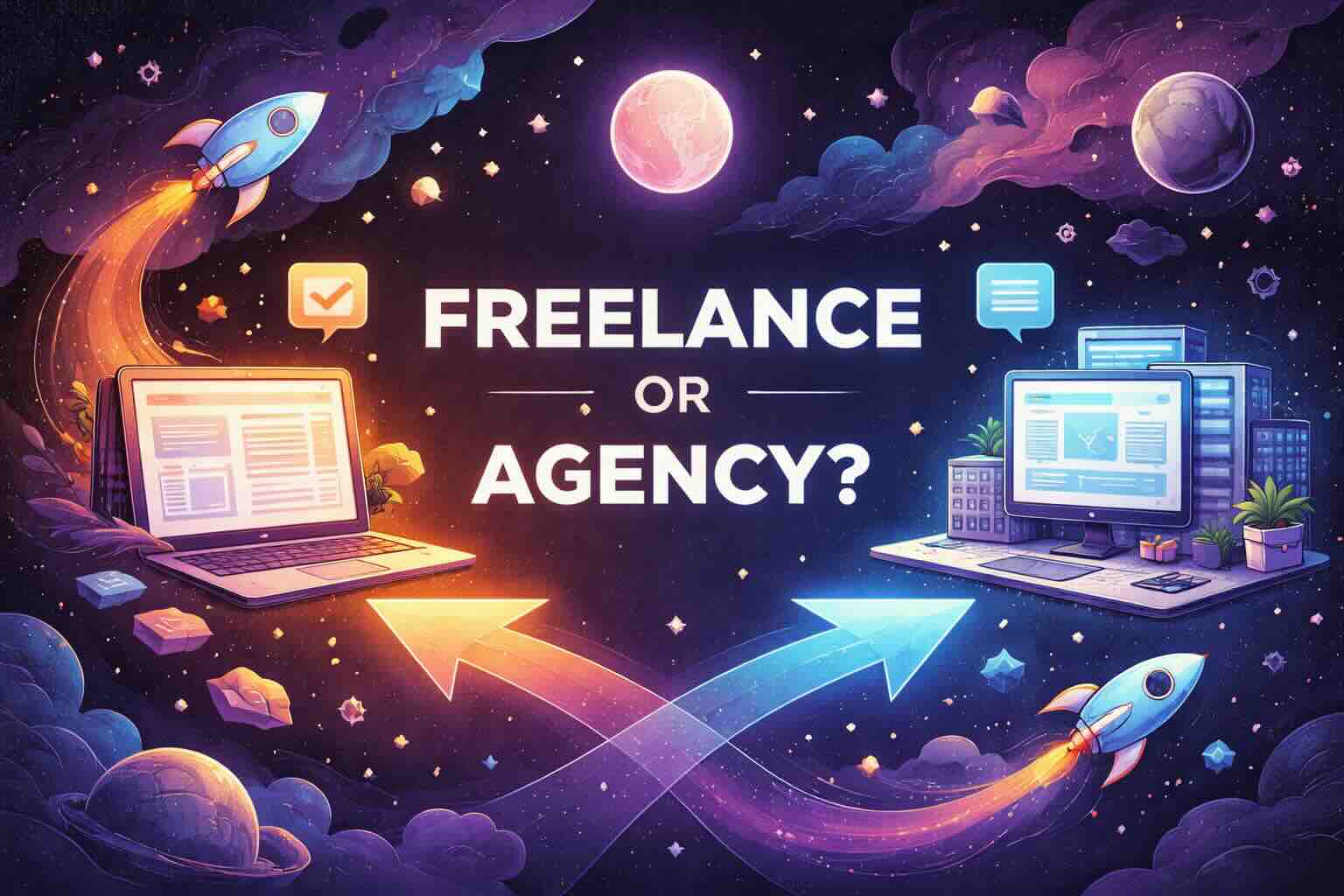
Freelancer vs agency, without hype or sales pressure, so you can make a decision you will not regret six months from now.
Choosing the right web developer for your business can feel more complicated than it needs to be.
If you are looking for someone to build or redesign your website, you will probably notice the same thing very quickly: everyone claims to be the right choice.
Agencies will tell you that you need a full team. Freelancers will tell you that agencies are too expensive. Website builders will tell you that you can do it all yourself. And somewhere in the middle, you are left trying to decide which option actually makes sense for your business.
The truth is that there is no single right answer for everyone.
A freelancer can be the best choice for one business. An agency can be the best choice for another. A simple DIY website can even be enough in the early stages of a business. The important thing is not choosing the option that sounds the most impressive. It is choosing the option that fits your goals, budget, timeline, and long-term plans.
This guide breaks down the real differences between a freelance web developer and a web design agency, without hype or sales pressure, so you can make a decision you will not regret six months from now.
Start With What Your Website Actually Needs to Do
Before comparing freelancers, agencies, or website builders, it helps to step back and ask a simpler question:
What does your website actually need to do?
Most small business websites do not need to be complicated. They need to explain what the business does, who it helps, where it operates, and why someone should trust it. They need to load quickly, work properly on mobile, support basic SEO, and make it easy for visitors to enquire, book, call, buy, or take the next step.
That is the foundation of a useful website.
Notice how none of that depends on flashy animations, overcomplicated features, or the biggest possible team. A good website is not just one that looks modern. It is one that supports the business.
For a local service business, that might mean strong service pages, clear calls to action, local SEO structure, trust signals, reviews, and a simple enquiry form.
For an ecommerce business, it might mean clear product pages, a smooth checkout, reliable payment setup, shipping options, and an easy way to manage orders.
For a consultant, studio, or creative business, it might mean a strong portfolio, clear positioning, case studies, and a website that reflects the quality of the work.
Once you understand what the website needs to achieve, it becomes much easier to choose the right web developer for your business.
Freelancer vs Agency: The Labels Do Not Tell the Whole Story
One of the biggest mistakes business owners make when hiring a web developer is focusing too much on labels.
“Freelancer” and “agency” sound like clear categories, but they do not tell you much on their own.
There are excellent freelance web developers who produce high-quality, strategic, technically strong websites. There are also freelancers who disappear halfway through a project, rely too much on templates, or struggle with communication.
The same is true for agencies. Some agencies are highly organised, creative, and effective. Others are expensive, slow, overloaded, or outsource most of the actual work while still charging agency prices.
There are also small studios, solo developers with specialist partners, larger agencies with junior teams, and independent developers who offer a more complete service than you might expect.
So instead of asking, “Should I hire a freelancer or an agency?” it is often better to ask:
Who will actually be doing the work?
How do they communicate?
Do they understand my type of business?
Can they explain their process clearly?
Do they care about the website after launch?
Will this website be built properly for long-term use?
Those questions matter far more than the label.
When Hiring a Web Design Agency Makes Sense
A web design agency can be a good choice if your project needs multiple specialists working together.
For example, you might need brand strategy, copywriting, user experience design, web development, SEO, paid advertising, analytics, content planning, and ongoing marketing. If the project is large enough, having a full team can make sense.
Agencies can also be useful for larger companies that need formal project management, multiple stakeholders, scheduled reporting, workshops, and a more structured process. If your website is part of a wider rebrand, marketing campaign, or complex digital system, an agency may be better equipped to handle that level of work.
A good agency can bring experience, structure, and a wider range of skills.
However, that comes with trade-offs.
Agencies usually cost more because you are paying for the team, the process, the overheads, and the account management. Communication may also pass through several people before it reaches the person actually designing or developing the website.
That is not always a bad thing. For some projects, that structure is useful. But for many small businesses, it can feel like too much.
If you need a clear, fast, well-built business website, you may not always need a full agency behind it.
When Hiring a Freelance Web Developer Makes Sense
A freelance web developer can be a strong choice for small businesses, startups, service providers, trades, consultants, ecommerce brands, and creative businesses that want a more direct process.
One of the biggest benefits of working with an independent web developer is communication. In many cases, you speak directly with the person designing and building your website. That can make the process faster, clearer, and more personal.
A good freelance web developer can help with strategy, design, development, SEO structure, performance, hosting advice, domain setup, content organisation, and post-launch support. Many freelancers are not just “someone who builds pages.” They understand how websites support real business goals.
For many small business websites, that is enough.
You may not need a large team. You may need one capable person who can understand your business, build the right structure, make sensible design decisions, and keep the project moving without unnecessary layers.
Freelancers can also be more flexible. They can often adapt more easily to your budget, timeline, communication style, and priorities.
However, choosing the right freelancer matters.
A weak freelancer can create just as many problems as a weak agency. The key is to look for someone who has a clear process, relevant experience, good communication, a strong portfolio, and an understanding of what happens after the website goes live.
The DIY Website Option
It is also worth mentioning the DIY route.
Website builders like Wix, Squarespace, Shopify, and WordPress page builders have made it easier than ever for business owners to create their own websites. For some early-stage businesses, this can be a sensible starting point.
If you are testing an idea, working with a very limited budget, or only need a basic online presence, building your own website may be enough for now.
The issue usually comes later.
DIY websites can become limiting when you need stronger SEO, better performance, a more professional design, custom functionality, improved conversion rates, or a structure that supports long-term growth.
Many business owners start with a DIY website and then eventually reach a point where it no longer reflects the quality of the business. That is often when hiring a web developer becomes worthwhile.
There is nothing wrong with starting simple. The main thing is knowing when the website has started holding the business back.
What Most Small Business Websites Really Need
Most small businesses do not need the most expensive website possible. They need a website that is clear, reliable, and built around their actual customers.
A strong small business website usually needs:
Clear messaging that explains what the business does
A professional design that fits the brand
Fast loading times
Mobile responsive layouts
Simple navigation
Strong calls to action
Basic technical SEO
Proper heading structure
Optimised service or product pages
Trust signals such as testimonials, reviews, case studies, or project photos
Easy contact options
A content management system that is not painful to update
Reliable hosting and maintenance
These are not glamorous things, but they matter.
A website can look impressive and still fail if visitors do not understand what to do next. It can have beautiful visuals and still perform badly if it loads slowly. It can be full of clever effects and still bring in no enquiries if the structure is unclear.
The right web developer should care about how the website works, not just how it looks.
Questions to Ask Before Hiring a Web Developer
Before hiring a web developer, it is worth asking a few practical questions.
Will the website be fully mobile responsive?
Is SEO included in the structure of the website?
Will the website be fast and performance-focused?
Can I update the website myself after launch?
Who will manage hosting, domain setup, and technical settings?
Will you help organise the content and page structure?
How will the website help generate leads or sales?
What happens after the website goes live?
Do you offer support or maintenance?
Will I own the website when it is finished?
Are there any ongoing costs I should know about?
These questions help you understand how the developer thinks.
A good web developer should be able to explain things clearly without hiding behind jargon. They should not make you feel stupid for asking basic questions. They should help you understand what you are paying for and why it matters.
If someone cannot explain their process clearly before the project starts, communication is unlikely to improve once the project is underway.
Red Flags to Watch Out For
When choosing a web developer, there are a few warning signs to look out for.
One major red flag is vague pricing. A website project does not always need a fixed price from the first message, but you should understand what is included, what is not included, and what could increase the cost.
Another red flag is overpromising. Be careful with anyone who guarantees instant Google rankings, unrealistic traffic, or huge results without understanding your business.
Poor communication is also a warning sign. If someone is slow, unclear, or disorganised before you have paid them, that may continue during the project.
You should also be cautious if the developer only talks about visuals and never mentions performance, SEO, usability, content structure, mobile experience, or conversion.
A website is not just a design file. It is a working business asset.
The best web developers think about the full picture.
Cheap Websites Can Become Expensive Later
It is understandable to care about price. Every business has a budget, and not every project needs a large investment.
However, choosing the cheapest web developer can sometimes cost more in the long run.
A cheap website may look fine at first, but problems often appear later. It might be hard to update, slow to load, poorly structured for SEO, difficult to expand, or built using plugins and templates that create technical issues.
Six months later, the business owner may need to pay someone else to fix it, rebuild it, or start again.
That does not mean you need to choose the most expensive option. It means you should look for value rather than just the lowest price.
A good website should save time, support enquiries, build trust, and grow with the business. If it does that, it becomes an investment rather than just another expense.
Think About the Website After Launch
One thing many business owners forget is that the website launch is not the end of the project.
After launch, you may need updates, backups, security checks, plugin maintenance, content changes, SEO improvements, new pages, analytics tracking, or performance adjustments.
This is especially true for WordPress websites, ecommerce stores, and growing businesses that regularly update their services, products, or locations.
Before hiring a web developer, ask what happens after launch.
Do they offer ongoing support?
Can they help if something breaks?
Will they show you how to update the website?
Do they provide maintenance?
Can they add new features later?
A website should not become something you are afraid to touch.
The right web developer should make the website feel manageable, not mysterious.
Choose the Person Who Understands Your Business Goals
The best web developer for your business is not always the one with the biggest portfolio, the flashiest design style, or the lowest price.
It is the one who understands what the website needs to achieve.
If your goal is more enquiries, the website should be structured around lead generation. If your goal is more sales, the ecommerce experience needs to be clear and trustworthy. If your goal is credibility, the design, copy, and case studies need to support that. If your goal is local visibility, the website needs to be built with local SEO in mind.
A good developer will ask about your business, not just your colour preferences.
They will want to understand your services, customers, competitors, location, goals, and pain points. They will help you make practical decisions instead of simply saying yes to everything.
That kind of input is valuable because most business owners do not just need someone to build a website. They need someone to guide the process.
Freelancer vs Agency: Which Should You Choose?
If your project is large, complex, heavily strategic, or involves several departments and marketing channels, an agency may be the better choice.
If you need a high-quality small business website, a redesign, a WordPress website, a custom-coded site, an ecommerce store, or a more direct working relationship, a skilled freelance web developer may be a better fit.
The right choice depends on your situation.
An agency can bring a bigger team and a wider service offering. A freelancer can often bring more direct communication, flexibility, and a closer connection to the actual build.
Neither option is automatically better.
What matters is whether the person or team can build the right website for your business, communicate clearly, and support the project properly from start to finish.
Final Thoughts
Choosing the right web developer for your business is not about picking the most impressive-sounding option.
It is about finding the right fit.
Do you need a full agency team, or would a skilled independent developer be more practical? Do you need a completely custom build, or would WordPress be the right choice? Do you need ecommerce functionality, booking systems, service pages, SEO support, or ongoing maintenance?
The more clearly you understand what your website needs to do, the easier the decision becomes.
A good website should not just look nice on launch day. It should still make sense six months later. It should be easy to use, easy to manage, and built around the goals of the business.
Whether you choose a freelancer or an agency, choose someone who listens properly, explains things clearly, and builds websites with purpose.
That is how you end up with a website you do not regret.